Quantum Odyssey, a terrain made from Qwen's embeddings, and the difference between making complexity visible and making it thinkable.
A visualization does not simply show a system. It teaches us which thoughts the system permits.
Two projects arrived within days of one another, each attempting to turn an intimidating mathematical object into a place a non-expert might enter.
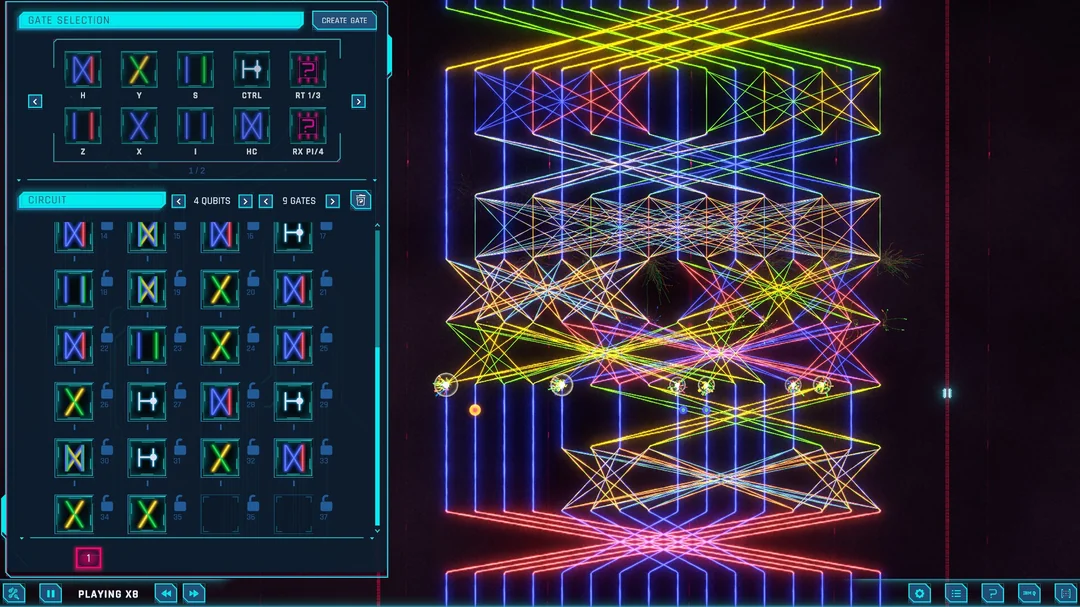
Quantum Odyssey is the result of roughly ten years spent developing a visual method for quantum computation. Its creator describes a complete Hilbert-space visualizer wrapped in open-ended logic puzzles: gates can be combined, systems evolved, and quantum algorithms watched as they unfold.
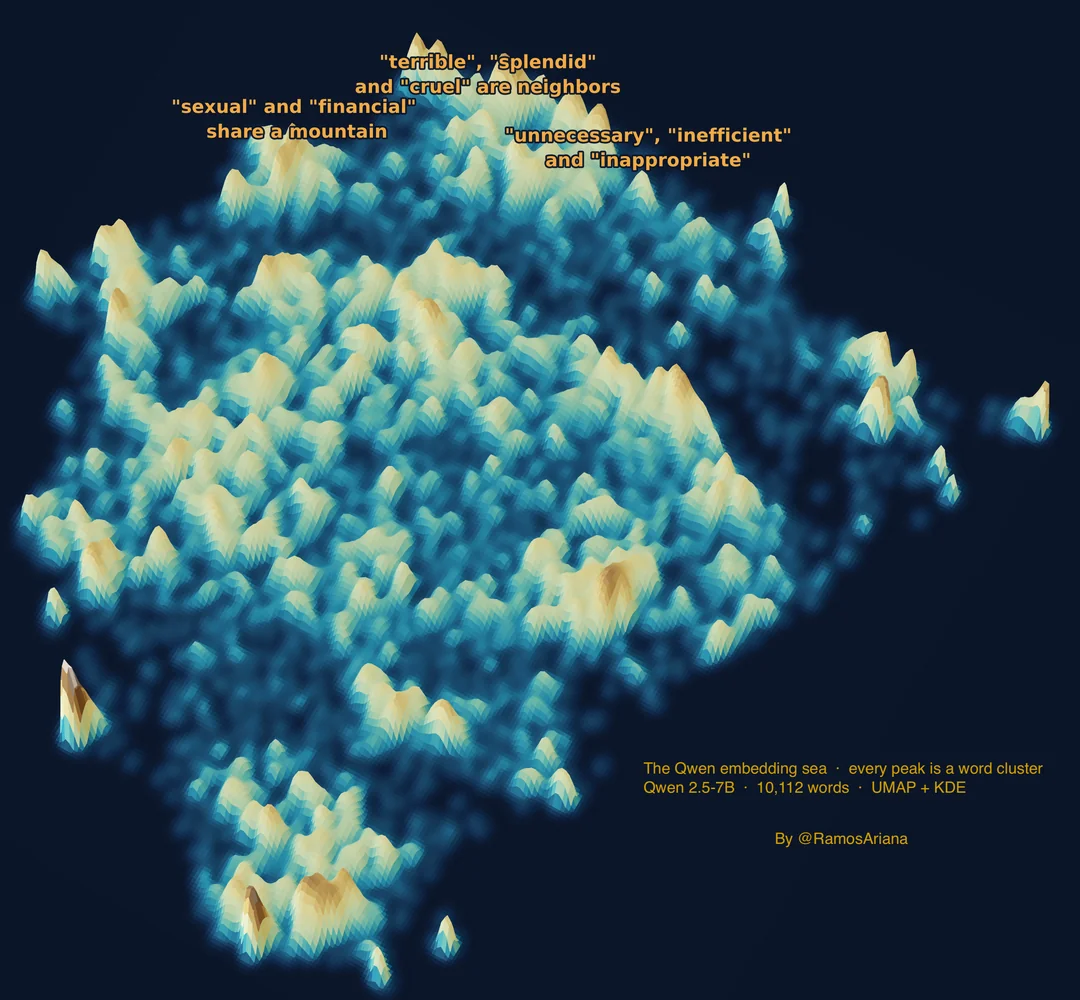
A separate Reddit project by Ariana Ramos begins from Qwen 2.5-7B's input embedding matrix. Approximately ten thousand filtered English words are projected from 3,584 dimensions into two, then presented as luminous terrain. Dense word regions rise as mountains. Sparse regions become ocean. Neighbourhood becomes geography.
One is an elaborate interactive system. The other, in its published form, is a static image and a proposal for a future explorer. Yet together they describe the two problems every visual interface to a complex system eventually encounters.
First: can the representation become a tool for reasoning rather than merely an illustration? Second: can it communicate the limits of that reasoning before the metaphor becomes more convincing than the measurement?
Criterion 01
Visible
Can the relevant state be perceived at all?
Criterion 02
Legible
Can the viewer understand what the marks, colours, positions and changes signify?
Criterion 03
Manipulable
Can the representation be used to form a prediction, intervene, and inspect the consequence?
Criterion 04
Trustworthy
Does the interface reveal what its visual grammar preserves, distorts and invents?
Case 01 // Quantum OdysseyImage supplied from the creator's Reddit post // quantum gates become visible operations inside a spatial system
Quantum Odyssey aims at something more demanding than illustration: a player should be able to perform quantum computation through the visual method itself.
The ambition resembles Kerbal Space Program. KSP does not primarily teach orbital mechanics by replacing play with explanation. It gives the player an instrument panel, a manipulable physical system, consequential failure and another attempt. Vocabulary becomes useful because it names regularities the player is already struggling to control.
That comparison appeared in the top response to the Quantum Odyssey post. The commenter praised the game as one of the rare systems capable of enabling deep domain-specific knowledge, then asked a more difficult question: what does working the problem actually look like? Is the visual method the best representation for deciding what to do next, or does it remain a shorthand for a large logic table that the player must carry elsewhere?
The distinction is exact. A representation may contain everything required to describe a system while still failing to support the human act of reasoning within it. Information can be present without being cognitively available.
The creator's answer was candid. All of the linear algebra had been made visual. The problem sets and tutorials attempted to leave nothing unexplained. Some players nevertheless found there was too much text; others skipped it and became stuck. People without mathematical backgrounds reached the leaderboards, while quantum-computing professors sometimes failed tutorial problems.
Representable is not automatically manipulable. Complete is not automatically approachable.
This is not evidence that the visualization failed. The same observations include striking evidence that it works for some people: learners without mathematical backgrounds have reached the leaderboards. What they establish is narrower. Visual completeness, instructional sequencing and individual cognition are separate design problems, and success is likely to vary across learners. A system may faithfully expose its dynamics while still asking too much of one player's working memory; another player may learn to reason through the same visual language.
Design test // Productive difficultyWhen the player fails, does the new state provide evidence for revising their model?
Productive difficulty says: “I see what happened, and I want to try a different account.” Unproductive difficulty says: “Something happened, but I do not know what the result tells me.” The difference is not whether the problem is hard. It is whether failure sharpens thought.
For Mesocosm, Quantum Odyssey establishes a demanding target. The interface should not begin by transferring a body of terminology. It should let a person notice a pattern, care about the consequence, manipulate the conditions, and only then acquire a name for what they have already begun to understand.
The ideal moment is predictive. A player who began with no formal vocabulary starts to say: if I change this, that pattern should appear. At that point the representation has crossed from spectacle into a cognitive instrument.
Case 02 // Qwen embedding terrainImage by Ariana Ramos // Qwen 2.5-7B // approximately 10,112 filtered words // UMAP and density rendering
The Qwen terrain succeeds immediately at something the original matrix cannot do: it provokes geographical curiosity.
Why do “sexual” and “financial” share a mountain? Why are “terrible,” “splendid” and “cruel” neighbours? Which rare words live alone in the ocean? What occupies the coastlines between clusters?
A matrix of token embeddings does not naturally invite those questions from a non-specialist. The terrain does. It gives an unseeable arrangement landmarks, texture and memory. It turns inspection into exploration.
But geography is not neutral decoration. It brings a powerful inherited grammar. On an ordinary map, nearby places are nearby. Direction is stable. Elevation has a consistent physical meaning. A route across the surface corresponds to a route through the territory. The embedding terrain appears to inherit all four claims even though only some are supported, and then only under qualifications.
The published process passes through several acts of authorship: the vocabulary is filtered through an English dictionary; related word forms are stemmed; cosine relationships in 3,584 dimensions are compressed into two dimensions with UMAP; density becomes elevation; smoothing determines whether points form one hill or several; and a handful of memorable labels are selected from thousands of candidates.
UMAP is particularly relevant because it is designed to preserve local neighbourhood structure more strongly than global geometry. Nearby points can therefore be meaningful local neighbours without the whole image functioning as a metrically faithful world map. The islands may be arranged beautifully, but the apparent distance between distant archipelagos should not automatically be read as an exact measurement.
The most productive description came from another commenter: this is one artist's rendition of the latent space. That need not be dismissive. Scientific visualization is always designed. The relevant question is whether the design makes its acts of translation inspectable.
Map promise 01Proximity means relation
Which distance is being shown, and how stable is the neighbourhood across projection settings?
Map promise 02Height means density
Density of which selected population, in which space, under which kernel and smoothing choice?
Map promise 03Ocean means absence
Is a sparse region intrinsic to the model, or produced by filtering, projection and sampling?
The terrain is therefore not best understood as a picture of the embedding space. It is a designed instrument for generating hypotheses about that space. Its future interactive version could earn increasing trust by letting a visitor search a word, inspect its original nearest neighbours, compare projected and original distances, change projection settings, and watch the terrain reorganize.
Uncertainty does not need to remain in a disclaimer beneath the map. It can become manipulable material inside the map.
The two case studies occupy different edges of the same design space.
QuestionQuantum OdysseyQwen terrain
Primary achievementFormal operations become visible and executable.High-dimensional structure becomes memorable and explorable.
Central riskRepresentational completeness may coexist with cognitive overload for some learners.Immediate intuition may exceed what the projection can faithfully support.
Critical testCan a player decide what to try next inside the visual system?Can a viewer tell which spatial relationships are measured and which are authored?
Lesson for MesocosmMake experimentation produce intelligible evidence.Treat every visual property as an explicit promise.
Mesocosm already lives inside this tension. Its layers become places. Measurements become routes. Repeated destinations become landmarks. These translations are useful precisely because the underlying computation cannot be perceived directly. They carry interpretive risks for the same reason.
A thread through the starmap can be remembered as something that climbed, crossed or branched. That spatial memory may help a person notice recurrence and form a hypothesis. But the visible route must not quietly become a claim that information literally travelled along the drawn line. The representation should support a thought while preserving the possibility that the thought is wrong.
A trustworthy instrument does not merely warn that its metaphor can fail. It gives the user a way to make the metaphor fail in public.
This suggests a practical standard for future Mesocosm systems. Position, distance, height, colour, thickness, movement and persistence should each have a stated semantic contract. When the underlying measurement cannot support the intuitive reading, the interface should reveal the contradiction: alternate projections, controls, runner-up states, changed metrics, or a view outside the visual metaphor that generated the idea.
The goal is not to eliminate metaphor. That would eliminate the interface. The goal is to make metaphor accountable.
Working standard // MesocosmCan someone use the representation to form and test a prediction—and can the representation show them when its own visual language misled them?
Visible, legible, manipulable and trustworthy are not stages completed once. They are pressures that every new visual system must negotiate again.
Case-study principle // 01The map earns trust when it can expose where the map stops being the territory.
Complexity becomes thinkable through designed representations. The responsibility is not to avoid design, but to make every visual promise available for inspection.