A sentence or reduced string is sent through GPT-2 Small.
Field note // building a game about discovery
The ceremony handles the math.
What Kerbal Space Program, Sailwind, and a navigable GPT-2 Small suggest about instruments that hide complexity without pretending it is not there.
A game does not need to expose every equation. It needs actions and instruments honest enough for useful intuition to form.
01 // A blunt instrument
Fly around
inside the model.
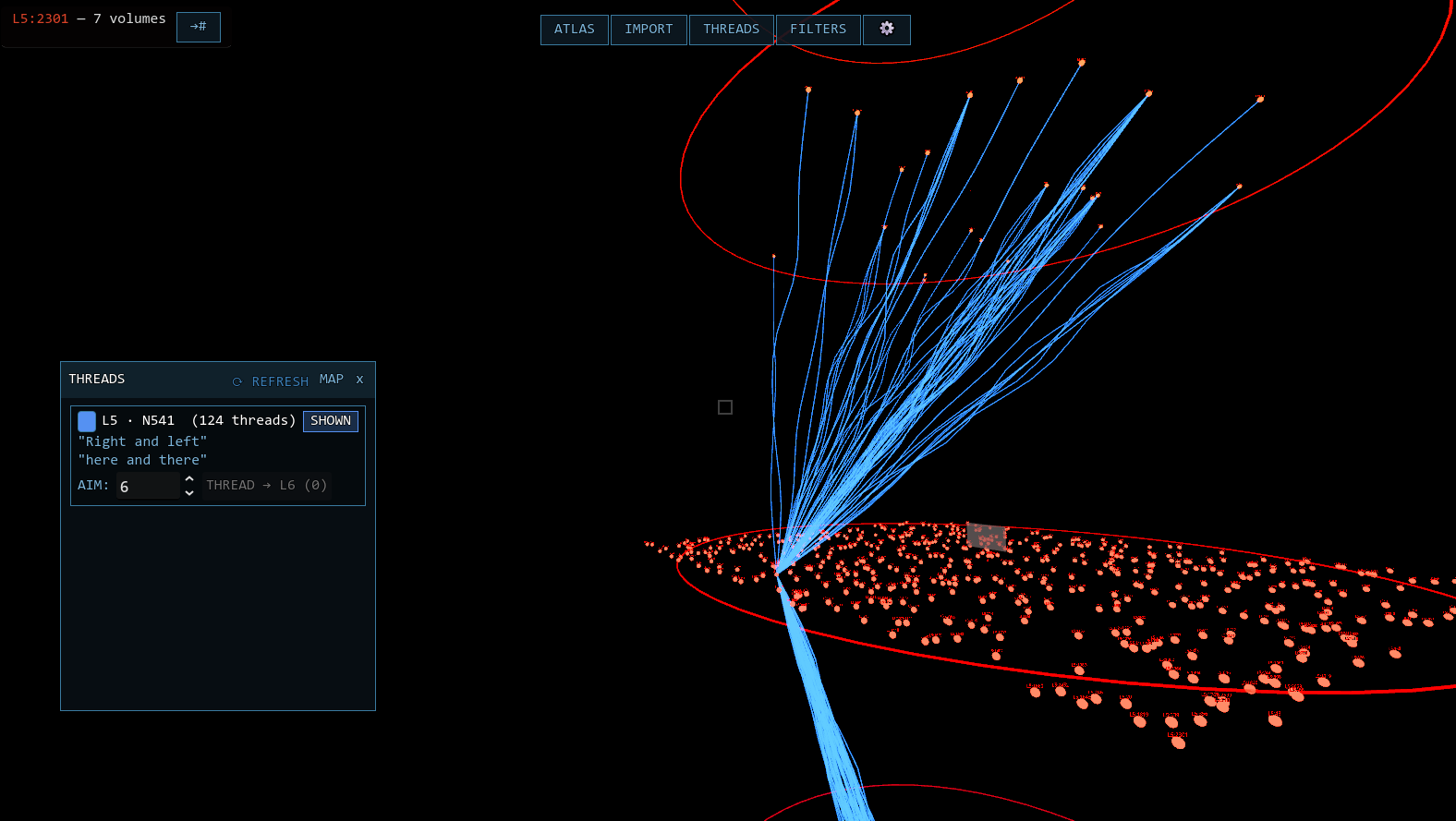
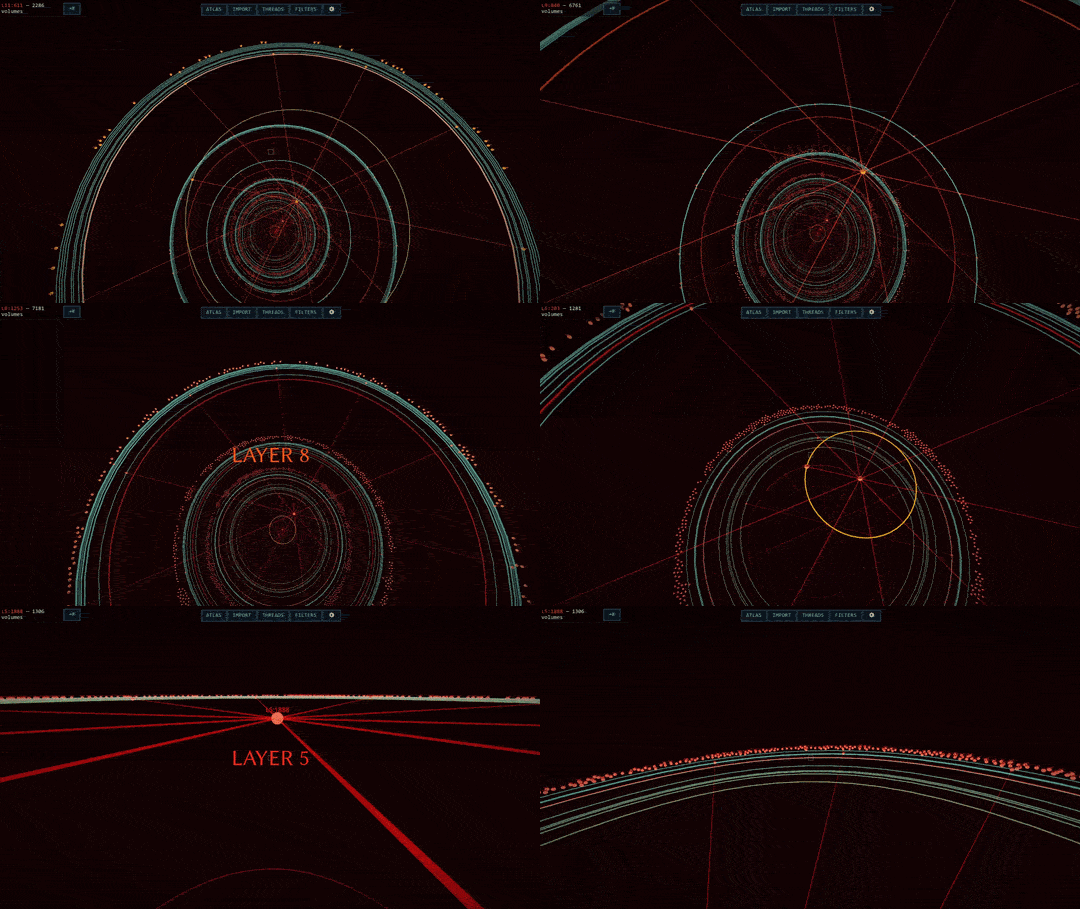
I spent the last few days messing in Godot with Claude, converting an old 2D UI into a 3D one so I can fly around inside GPT-2 Small, speak to it live, or run pre-computed books through it and see what that “looks like.” Each red sphere is a neuron; each plane is a post-activation MLP layer. Neurons are only visible when they light up.
A lit neuron is the layer's “winner” for a given input—for now, often a sentence of Moby-Dick. It wins when it has the highest activation observed across every token position in that text. This is a blunt instrument, but one with some utility :P
Each neuron's strongest post-activation response is retained.
The highest of those neuron peaks becomes the layer's address.
Joining the winners across layers draws a trajectory—not a demonstrated flow of information.
02 // Discovery changes by layer
Where a game
becomes possible.
The utility for me is that this measurement makes changes between layers discoverable. I wanted to try a game where strings resolve to neuron indices as addresses and star systems, and the player is rewarded for finding “rare systems”: rare winners of the argmax.
At L4 the game is almost impossible because one neuron wins basically everything through this lens. At L5 the view suddenly widens into a universe of potential winners that are highly sensitive to the input. That is where a word-driven discovery game can exist.
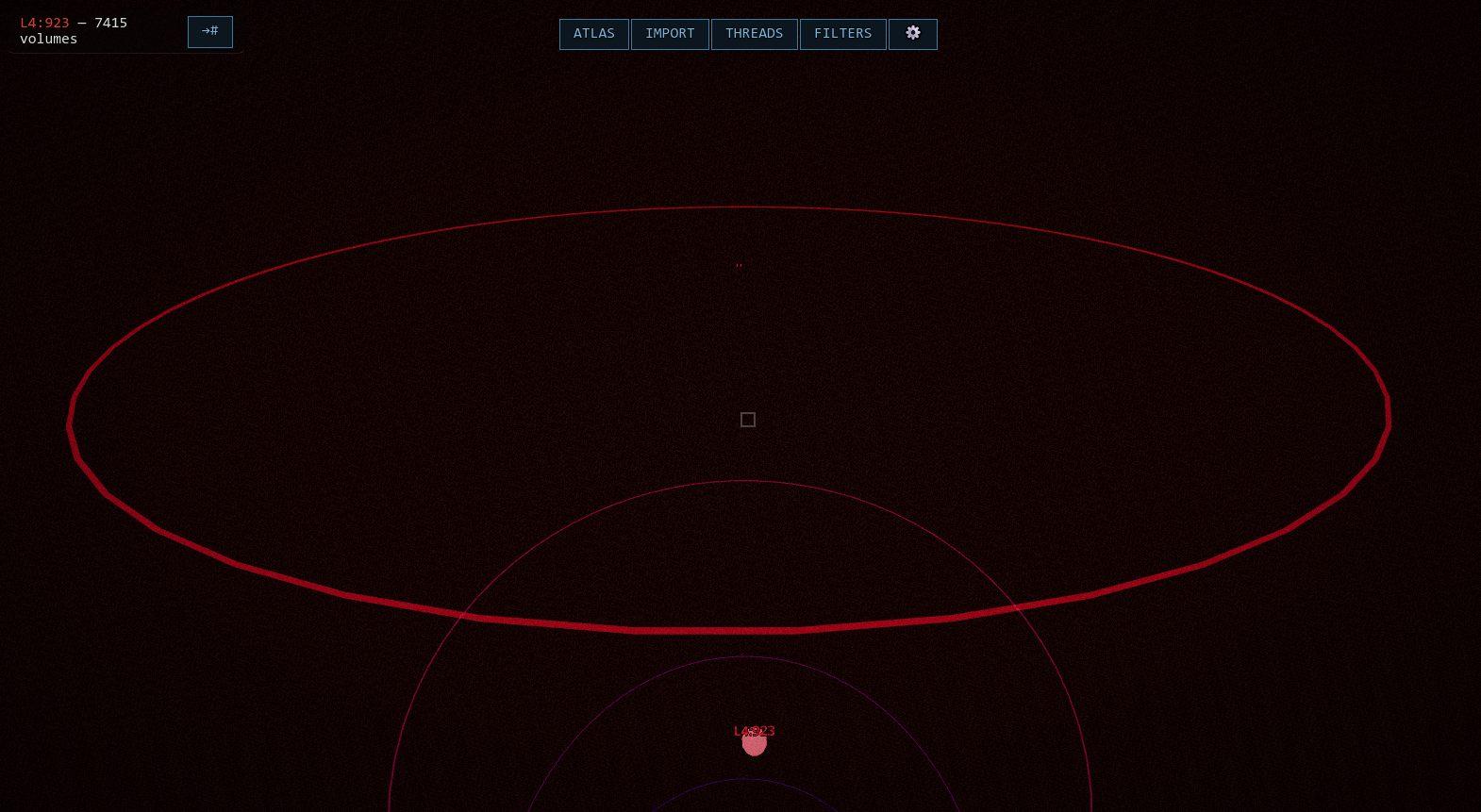
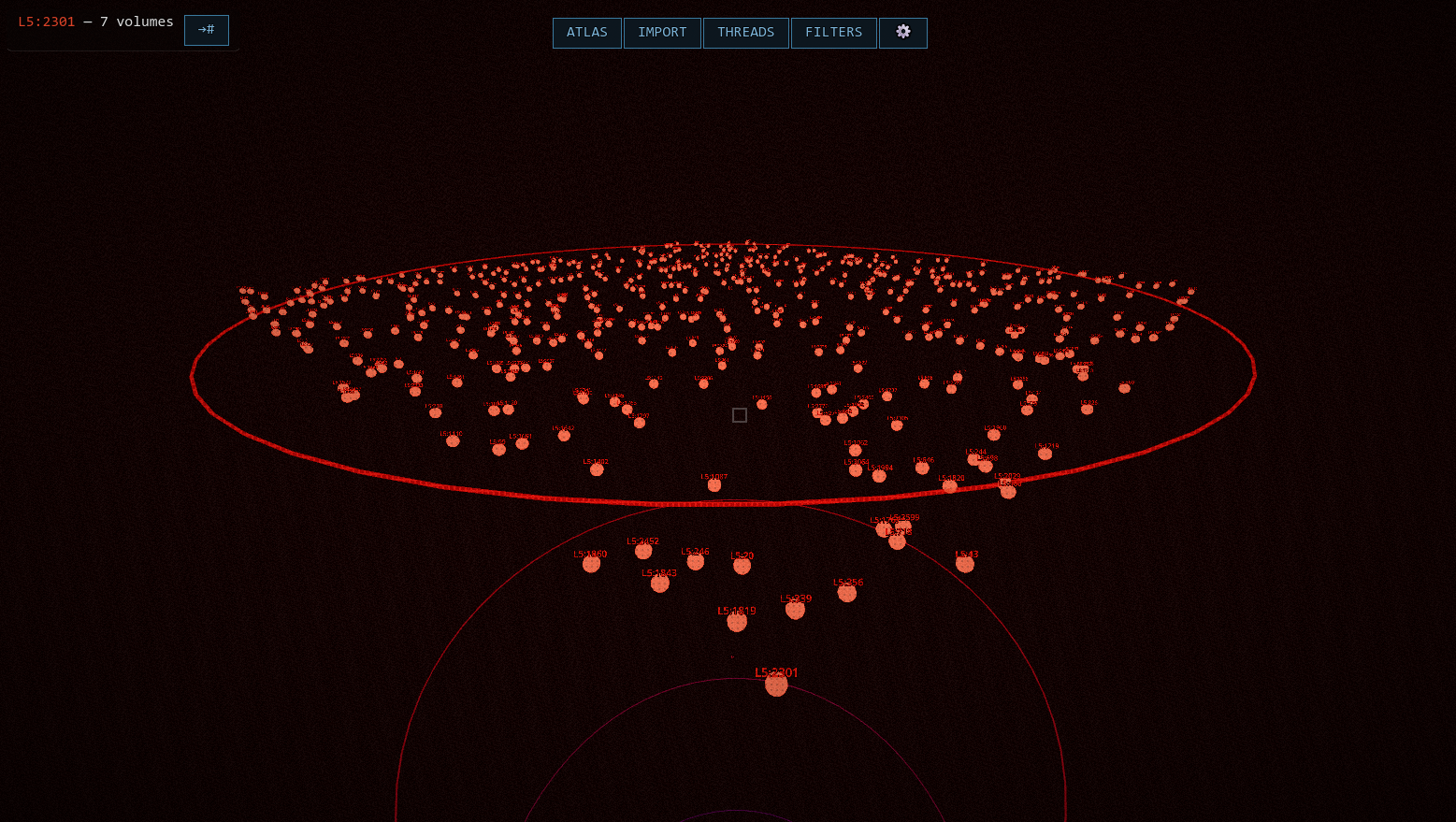
L4 // one winner dominates the book-wide atlas. The instrument produces almost no geography for a discovery game.
The game can notice something without pretending it has already explained it.
I said earlier that the game is not much of a tool for mechanistic-interpretability insight. That was a little harsh, but I am consciously trying to separate the game from the laboratory.
The prototype has already had some utility as a hypothesis generator. It motivated a barrage of tests, and because the rest of my stack was already set up, they took only a few minutes. I noticed visual branches around one neuron, left the game, spun up Python, and tested whether those branches survived timing checks and intervention. Some did. Others fell apart.
I do not necessarily want to put that laboratory inside the game. A generic set of tests could imply that every observation can be investigated in the same way, when the appropriate experiment often depends on the phenomenon. But if the game gets you curious enough to start writing tests, I feel like the design has won :P
The bridge outward
The most I might add is a better handoff to external tooling: detailed session records containing the exact inputs, measurements, caveats, methods, and reproduction steps, so a person—or an AI helping them—can turn something noticed in the world into a properly testable question.
Remove text while checking whether the measured response survives. The ritual reveals what the observation depends on.
Hold the text fixed and join its layer-wise winners. The ritual makes recurring trajectories spatially inspectable.
Preserve provenance, settings, values, and caveats. The ritual turns a remembered sighting into something another tool can challenge.
03 // Kerbal Space Program
First, go straight up.
Flight 01 // ascent
Launch in a direct line.
Imagine I launch myself on a rocket straight up into space. The controls make the action simple even though the world beneath them is already calculating a trajectory.
Flight 02 // apoapsis
Wait for the peak.
I wait until I reach the highest point of that trajectory: apoapsis. The map turns an invisible prediction into a place and a moment I can act on.
Flight 03 // orbital burn
Turn toward the horizon.
To enter orbit, I point somewhere along the horizon—in the direction I want to travel—and burn. I do not solve the orbital mechanics. I operate a navball and watch a line on the map bend into a predicted orbit.
04 // The orbit field
One burn.
Many planes.
Every ship begins at the same apoapsis. Burn speed sets the shape of the orbit; heading rotates that orbit around the local horizon. Let the field accumulate and the hidden family of possible paths becomes visible.
heading +180°heading 0°heading −180°
0 trajectories // heading 0° // 0.82× circular
Model boundary // This sketch uses single-body inverse-square gravity at a schematic scale. It is meant to expose the relationship between a tangential burn and an orbital plane, not reproduce Kerbal Space Program's complete simulation.
05 // Backstage mathematics
The scary face
under the navball.
For some of us, this is genuinely frightening notation. The symbols can be difficult to hold and manipulate in the head. The game does not make the mathematics disappear; it gives us another way to think through the same relationships.
This is not a test. You already used this mathematics before you saw it.
h = r × v
The difference between travelling directly away from a planet and beginning to move around it.
vc = √(μ / r)
The tangential speed that makes the predicted path close into a circle at that altitude.
ve = √(2μ / r)
The boundary where a closed orbit opens into an escape path.
v2 = μ(2/r − 1/a)
The compact relationship behind the speed, distance, and orbit drawn on the map.
Δε = v·Δv + |Δv|2/2
Why adding speed while already moving quickly changes orbital energy so effectively.
Δv = 2v sin(Δi/2)
For a pure instantaneous change that preserves speed, changing direction is cheaper where the spacecraft is moving slowly.
The game saysGo straight up.
The equation says that velocity parallel to the radius produces no angular momentum. You rise and fall along the same line.
The game saysPoint at the horizon.
The cross-product becomes nonzero. Position and tangential velocity now define an orbital plane.
The game saysWatch the line bend.
The simulation evaluates the relationship between speed, distance, and orbital shape, then draws the answer instead of asking you to solve it.
The game saysBurn at apoapsis.
After a vertical ascent, radial motion has paused and the below-circular tangential burn shown here raises the low side of the orbit. But apoapsis is not universally “best”: energy-raising burns benefit from high speed near periapsis, while plane changes benefit from low speed near apoapsis.
You understood it
before the symbols.
before the symbols.
The equation is compact symbolic thought. The game is spatial, procedural, visual, and narrative thought. The navball, horizon, manoeuvre direction, and projected line delegate the symbolic processing to the simulation without making the underlying relationship fake.
06 // Sailwind
How not to get lost at sea.
Kerbal Space Program turns orbital mechanics into a direction, a burn, and a line on a map. Sailwind performs the same trick more quietly: sunlight becomes a shadow; the shadow becomes a reading; the reading becomes a place in an otherwise featureless ocean.

A historical doorway // not a settled claim
If they could turn sunlight, a stone, and repeated observation into a way across an ocean, perhaps this does not have to begin with equations.
The idea that Viking navigators used crystalline “sunstones” to locate a hidden Sun through polarized light is physically plausible but historically disputed. The image opens the door; we need not pretend it closes the case.
The Sailwind ceremony
Every day around noon, ask the Sun where you are.
There is no glowing waypoint. The game gives me a clock, a wooden instrument, a chart, and a world consistent enough for their relationships to mean something.
- Wait for the gnomon's shadow to cross the centre line: local noon.
- Read where the shadow tip falls on the Sun Compass: latitude.
- Compare local noon with the chronometer's reference time: longitude.
- Put the two readings together on the chart, then correct course.
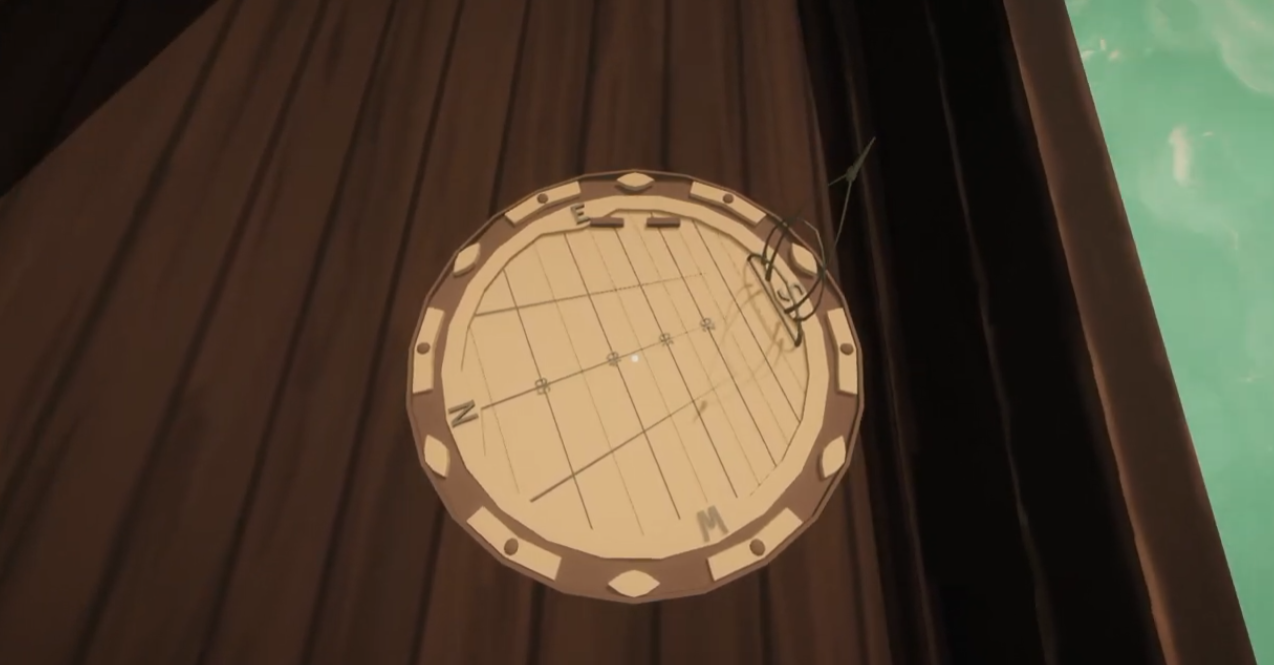
07 // The mathematics at sea
The scary face under the shadow.
The ceremony does not replace the astronomy. It packages the symbolic work into time, light, a gnomon, and marks on a dial. I can perform the relationship before I can comfortably process its notation.
This is not a test. You already crossed the ocean before you saw it.
tan(h) = g / s
For a vertical gnomon of height g casting a horizontal shadow of length s on a level surface, the shadow turns the Sun's angle above the horizon into something measurable.
h = 90° − |φ − δ|
Solar altitude and seasonal declination, together with which side of the zenith the Sun occupies, locate the ship north or south.
|Δλ| = 15° × |Δt|
The size of the time difference gives the longitude difference; whether local noon occurs earlier or later than reference noon determines east or west.
The ritual is another interface.
I cannot comfortably hold these equations in my head. But I can wait for noon, watch a shadow, compare two times, and put a mark on a chart. These are not lesser thoughts. They are another way into the same underlying world. The simulation does not remove the astronomy; it gives the astronomy handles.
08 // Closing reflection
From interface to experiment.
The ceremony does more than hide a calculation. At its best, it gives a human action whose outcome can answer a question about the world underneath.
Computation is delegated.
I do not solve the equation. The simulator does.
Representation is transformed.
A vector or equation becomes a navball, shadow, trajectory, neuron, or thread.
Experiment becomes procedural.
Do this. Observe that. Change one thing. Try again.
Question → ceremony → observation → falsifiable expectation
That distinction matters because these instruments do not all show the same kind of truth. Whittling asks what text can be removed while a response survives. Threading joins successive winners so recurring shapes become perceptible—but a continuous line is not a demonstrated causal path. A session record can preserve enough context for either observation to become a more careful experiment elsewhere.
Someone can play Kerbal Space Program without deriving orbital mechanics and still acquire useful counterfactual knowledge: burn here, in this direction, and the orbit will change roughly like that.
A player may not be able to describe a transformer algebraically, yet become surprisingly good at anticipating which textual changes will preserve, redirect, or destroy something they have observed.
That would be more than teaching transformer concepts through a game. It would be an environment for developing tacit experimental intuition about a real transformer.
The transformer supplies the world.
The instruments supply the handles. The ceremony lets a human nervous system participate before it is fluent in all the mathematics. Each instrument should perform one honest transformation—and support one question whose answer can still surprise the player.
09 // Human dev notes
Before it
became an essay.
The structured page above grew out of these working notes. This panel keeps the human phrasing—and its original paragraph rhythm—visible beside the collaborative interpretation.
I take inspiration from games like Kerbal Space Program. It doesn't simulate n-body gravity and has a much simpler "patched conics" system instead. But that's still honest enough to expose people to the field its based on and invite curiosity. That's the kinda needle I'd want a "mechinterp game" to thread. Less of a tool for genuine insight, more of a curiosity and intution builder. I know zero astrophysics but have the intution baked in that parallel burns to a planetary body at post-launch apoapsis will achieve orbit.
Or take Sailwind. I don't know azimuth math, but if I do a little ceremony: compass dial thing at noon every day, match it to a chart I bought - I can travel a whole ocean and not get lost. I don't need the math, if the ceremony handles it for me.
All of this is fairly complicated math. But it's all reduced, in the game, to a fairly simple tool and intuition: point the navball in the direction you want to go, around the horizon, and watch your predicted orbit change in the map. All of the math is done on the backend - all we see is a compass and a line drawn on a map, very simple stuff.
Sailwind does the same trick, essentially. I replace "aim for horizon and burn thrusters" ceremony for a midday ritual.
I check the clock for noon. When it comes, I hold out my [tool name] and let the shadows it casts point to a number.
I do very simple math, substraction, to correlate that to lat (or is it long)
The math is handled by again, by the tools the game gives me.
And in each case too, the game engine states are driving the reality/ontology in a way that is realistic enough to emulate the real thing.
The map's lines work to build intuition about gravity, because there is actually gravity to shape those lines.
The compass works because it casts a shadow, from a sun that follows an actual path, inside a larger cosmological ontology that enables celestial navigation - the midday ritual is just one navigation possibility, we have a north star, constellations, etc.
The physics/game engine beneath is doing real work to make the learning possible.
It's an important thing for me to consider in all this.
Basing the game inside the transformer creates that grounded reality - our parameters are constrained by the system we want to map, and that's a good thing.
But there is a real question about the tools a mechinterp game provides to the player, that is difficult for me to answer as a non-expert.
Another aspect of the game so far, is that tests sometimes have to be tailored to the phenomea observed. One neuron might respond like L5:N541 does, to pairing/parallels (up and down, wave after wave, shoulder to shoulder), while another responds to "for example" and "eg". It's not easy to think about a one-size fits all tool that helps across varied phenomena, but things like whittling/threading I think are examples of our game's "navball/sun-compass".
- Whittling asks what text can be removed while preserving a response.
- Threading asks how the same fixed text’s winner changes across layers.
- Logging (which doesn't exist yet) would preserves enough context to challenge what those instruments appeared to show in further experiments outside the game.
That could become a kind of design criterion, perhaps. Each instrument performs one honest transformation, whose process and limitations can be stated plainly.
Human-written working notes. Wording, spelling, punctuation, paragraph breaks, and intentional line breaks preserved. Passages already embodied elsewhere on this page, plus production directions, were omitted.
Postscript // after somebody checked the mathRocket go sideways.
Small confession: I do not know the equations on this page. I know the rituals. The formal account was added afterward to show that the behaviour I had learned corresponds to structure underneath it.
SUN. STICK. SHADOW. I KNOW WHERE BOAT IS.
ROCKET GO UP. NOW ROCKET GO SIDEWAYS. ORBIT.
ROCKET GO UP. NOW ROCKET GO SIDEWAYS. ORBIT.
Then someone checked the equations and found that our first latitude formula could send a southern observer north. We corrected the caption. The practical sun-stick-shadow knowledge never changed.
I could not independently audit the formalisation of a thing I demonstrably knew how to do. That is not an embarrassment hidden outside the essay. It may be the essay's most on-theme result.