“The strongest Mesocosm would be one that is willing to repeatedly damage its own ontology.” That sentence appears near the end of Convergent Methodology →, a critical field note about what Mesocosm might become as an instrument.
At first, damaging the ontology sounded like an epistemic standard. If stars become misleading, change them. If winner-take-all hides the phenomenon, expose more of the distribution. If neurons cease to be useful units for a question, allow the investigator to leave neurons behind.
Now it has become a practical design instruction.
The first thing being damaged is threads.
Threads
A thread begins with a neuron and a parcel of its Minimal Activating Exemplars: strings previously whittled down while preserving that neuron’s winning response.
Mesocosm resolves those strings at another layer and records their argmax destinations there. When the strings converge on a neuron at that layer, the interface draws a glowing tube between the original neuron and the new destination. Repeating the operation produces routes, bundles and branches through the starmap.
The relation is honestly computed.
A thread records address co-resolution: strings that win one neuron at one layer also win another neuron when measured at a different layer. It does not fabricate the values behind the visualization.
But technical accuracy is only one part of interface design.
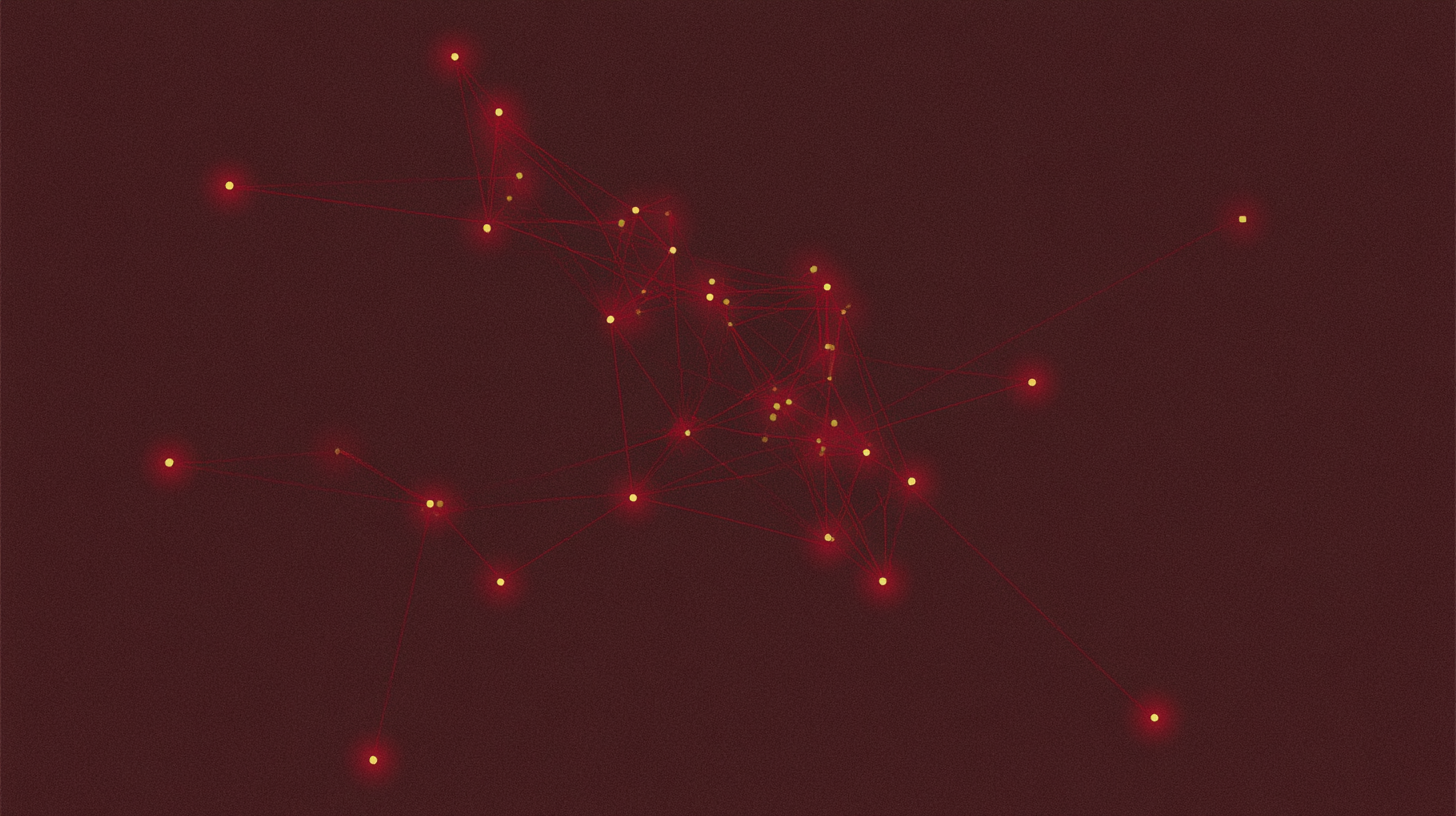
A glowing tube connecting two nodes is about as universal a visual grammar for “these are connected, something flows between them” as exists.
That reading does not require specialist knowledge. A player does not need to know what a causal circuit is to see a glowing tube as a pathway. The specialised interpretation—perhaps that one neuron causally feeds another—is only one version of a more ordinary impression: these points are connected; something passes between them; this route can be followed.
The complete experience reinforces that impression. Threads stretch through a spatial world. They join destinations, branch, glow, persist and can be travelled alongside. Every part of the interaction conjugates the measured relation as a route.
The design has already spoken
An interface communicates through both the data it displays and the visual language it uses to display it. A visualization is not accurate merely because every mark was generated from accurate data. The organisation of those marks also tells the viewer what kind of relationship they are seeing.
- Lines suggest connection.
- Arrows suggest direction.
- Branches suggest divergence from a shared source.
- Animation suggests movement.
- Persistence suggests an enduring property of the world.
- Spatial proximity suggests similarity or interaction.
None of these meanings needs to appear in a caption. They arrive through ordinary visual literacy, often before the viewer has consciously interpreted the display.
This gives interface design a responsibility beyond correct computation. The designer has to ask what a person will learn from the arrangement. Which relationships become cognitively primary? What verbs does the interface suggest—flow, travel, contain, accumulate, compare? What explanation will the viewer construct before reading the documentation? Does repeated interaction strengthen an intuition that the measurement supports?
A disclaimer cannot necessarily repair a visual primitive whose familiar meaning exceeds the evidence. If the interface says “pathway” continuously through shape, animation, space and interaction, a sentence underneath it is not an equal participant in the experience.
The design has already spoken.
The ceremony teaches
This connects directly to The Ceremony Handles the Math →, which asks how Mesocosm might develop something like its own navball.
Kerbal Space Program does not require a player to derive orbital mechanics before attempting an orbital manoeuvre. Its instruments embed mathematical relationships inside repeatable perceptual operations. Through use, a player develops expectations: burn here and the orbit will change like this; rotate this marker toward that one and the craft will acquire the required orientation.
The player may acquire operational competence before formal mathematical fluency. That is the promise contained in the phrase “the ceremony handles the math.”
Threads reveal the responsibility contained in the same phrase.
An interface capable of cultivating intuition can cultivate the wrong intuition. A player may become fluent in following glowing routes through Mesocosm without the underlying measurement ever having established that those routes exist as computational pathways. The ceremony can work perfectly as an interface while teaching the proposition supplied by its own visual grammar.
What kind of intuition does repeated use of this instrument train?
A navball is not a literal miniature of the space around the craft. Its value comes from operational fidelity. The abstraction helps the player form expectations that remain useful when they act on the spacecraft.
Mesocosm does not need to resemble the model in any simple physical sense either. It needs to cultivate intuitions that remain useful when checked against the model.
STRATA
Threads will remain as v1 of the idea, preserved in the project and its development history. A second instrument is now being built alongside them. It is called STRATA.
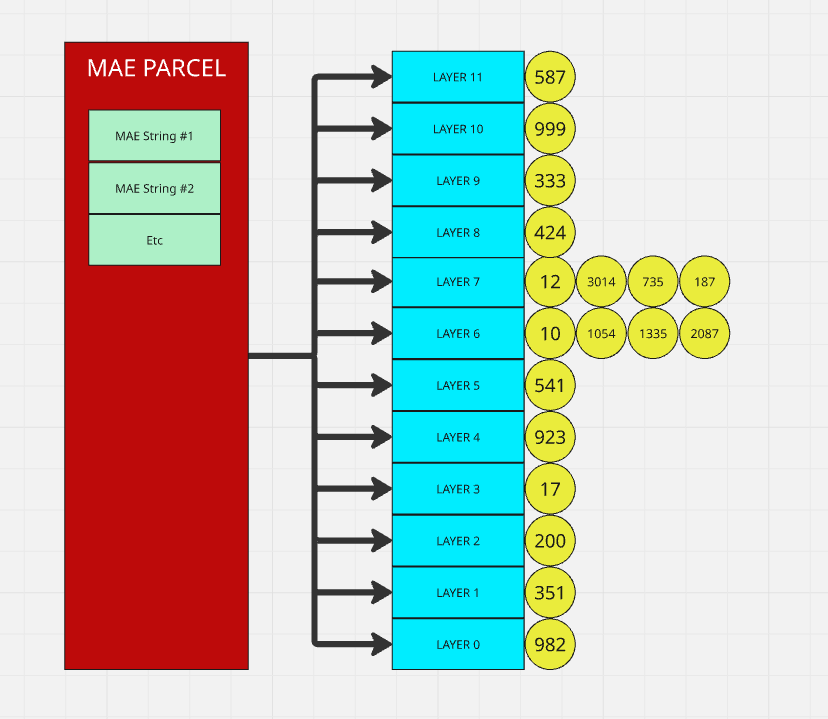
STRATA takes one already-discovered neuron’s parcel of Minimal Activating Exemplars and resolves those strings across all twelve layers of GPT-2 Small. It presents the results as a stack of layer-rows. Each row shows the neuron addresses selected by the parcel’s strings at that layer.
One parcel becomes a twelve-layer reading.
The layers retain their order. Their results appear as adjacent rows that can be inspected and compared. Repeated destinations, dispersion, convergence and changes in the parcel’s address structure become visible across the stack.
From diagram to instrument
The first implementation pass carries the mockup’s simplest commitment into the world: twelve ordered rows, one for each layer, assembled into a single object beside the player. At this stage the structure is deliberately bare. The colour progression makes layer order visible; the rows provide a place for the readings; the object can already be approached, circled and inspected at game scale.
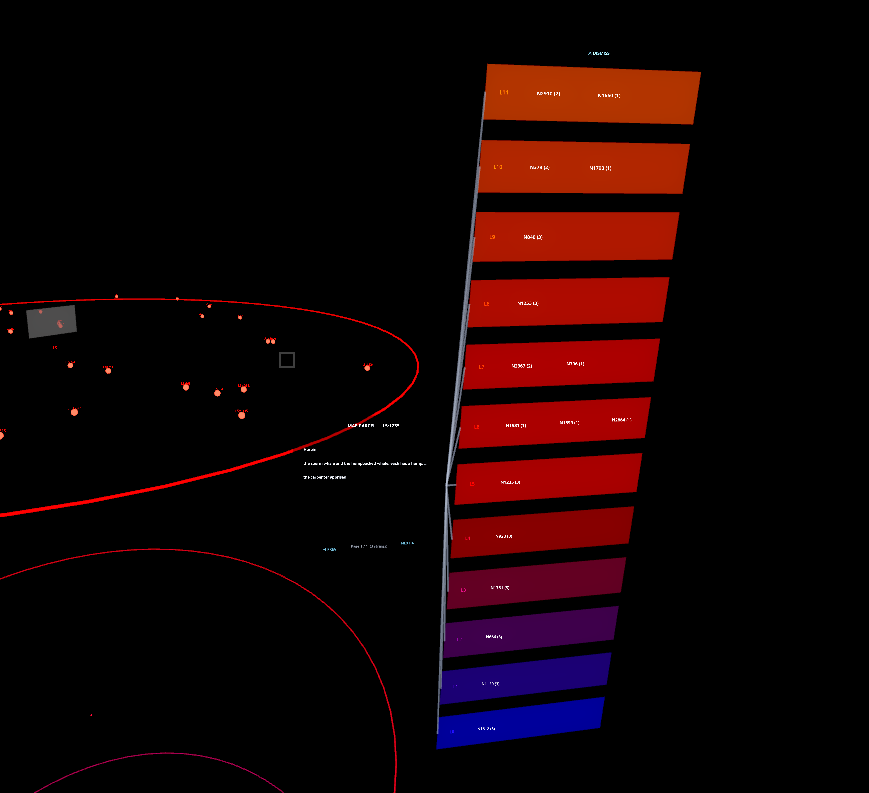
The next pass begins pulling Mesocosm’s existing neuron-stars into the new instrument. The addresses stop reading as text printed onto a panel and become recognisable inhabitants of the atlas: coloured stars, labelled by layer and neuron, arranged within the row that reported them.
This matters beyond visual polish. STRATA is not a separate dashboard laid over Mesocosm. It is an instrument made from the world’s existing vocabulary, reorganised around a different operation. The neuron-stars retain their identity while their arrangement changes from spatial route to layered reading.
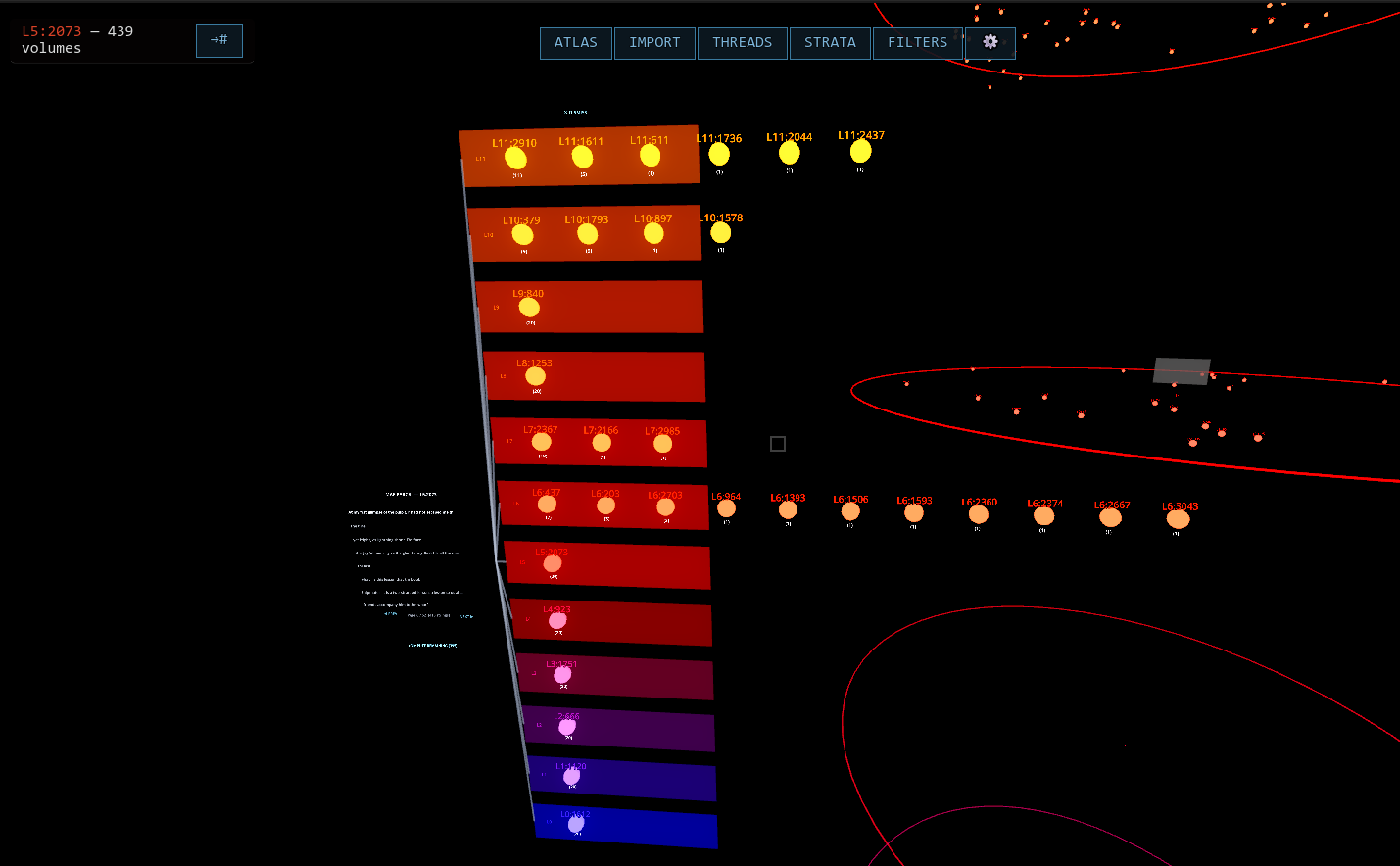
V3 resolves several of the immediate display problems exposed by that pass. The layer rows become more legible at close range, neuron labels and counts settle into a clearer hierarchy, and the stars read more coherently as the contents of each layer’s result.
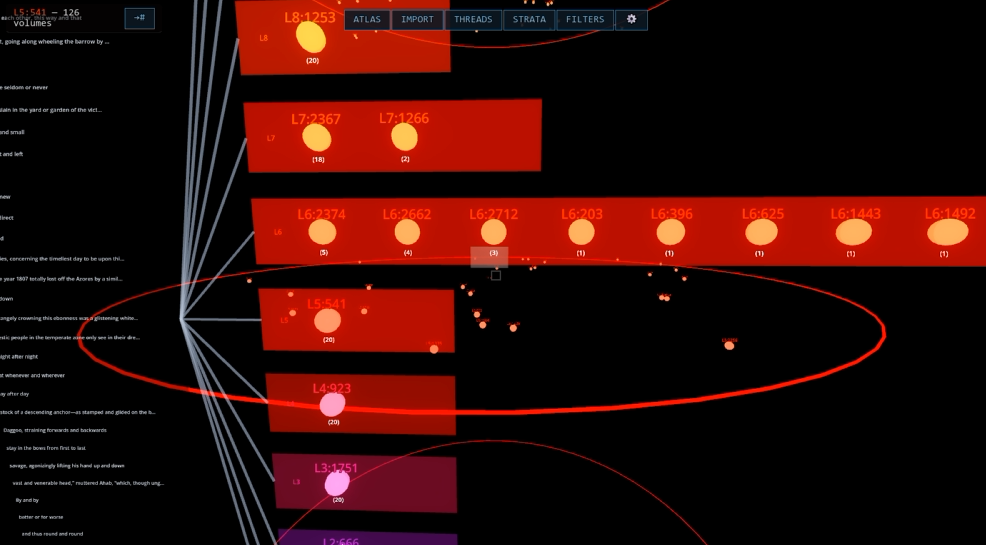
For the time being, this is STRATA’s current resting point. The three captures remain valuable as a compact development record: a bare layer stack becomes populated by neuron-stars, then gains the hierarchy needed to read those results inside the world. They show which decisions survived the move from mockup to three-dimensional instrument—and which perceptual problems only became visible once the object was walkable.
The object is conjured in the world at the player’s current position and oriented to the direction they are facing. This reuses the existing Rank View and Spotlight precedent: a player-anchored inspection object that can be walked around and read from useful positions.
That interaction is part of the design. STRATA appears as the result of an operation performed on a particular parcel. The inspection surface is summoned where the player stands, but the discoveries it produces persist. Every newly encountered neuron becomes an atlas entry, and STRATA adds another category to that accumulating record: strata hits.
The instrument therefore does more than present a reading produced here and now. It changes the atlas. A temporary act of inspection leaves permanent evidence of where the parcel landed, expanding the world through the same discovery logic that already governs Mesocosm.
Its governing image is closer to a geological cross-section than a wiring diagram: ordered layers, each carrying the result found at its depth.
The geological metaphor will have its own consequences. Strata can imply accumulation, deposition, age and material transformation. The transformer layers are computationally sequential; each layer receives a state shaped by the preceding computation. The readings are separated for comparison while the computation that produced them remains layered and sequential.
V2 is not absolution
STRATA is the current attempt, not the final correction to a solved design problem.
Rows, stacks, circles, parcels and geological language all carry meanings. They will make some relationships easier to perceive and encourage some interpretations over others. Some of those interpretations may prove useful. Others may become STRATA’s equivalent of the glowing pathway.
The relevant question is what people come to believe after using it.
- Can a player explain what each row records?
- Do they recognise concentration and dispersion across a parcel?
- Does repeated use improve their expectations about what will happen when a string is changed, removed or replaced?
- Do patterns noticed through STRATA survive inspection through other measurements?
- Which misconceptions recur without prompting?
A successful instrument should produce more than immediate legibility. It should cultivate increasingly reliable expectations about the object being investigated.
That can only be discovered through use.
The Ship of Theseus instrument
Mesocosm has accumulated a vocabulary: stars, rooms, routes, threads, bundles, arrivals, parcels and now strata.
None of these terms has tenure.
The project can remain recognisably Mesocosm while every representational component is eventually replaced. Its continuity does not need to reside in the permanence of its map. It can reside in a smaller set of commitments:
- make the underlying operation inspectable;
- distinguish measurement from interpretation;
- make comparison and manipulation cognitively available;
- preserve the history of mistakes;
- test the expectations produced by the interface;
- redesign when the experience teaches more than the evidence supports.
In that sense, Mesocosm is becoming a Ship of Theseus instrument. Its ontology rebuilds itself while it is being used.
But the discarded pieces do not disappear.
Threads remain v1. Their measurements, affordances and distortions remain available for comparison. The project becomes both ship and museum: a changing instrument accompanied by a record of the things it once taught its users to see.
For an ordinary product, this degree of ontological instability might look like failure. For a game prototype that is also trying to become an investigative instrument, it may be a form of calibration.
The strongest Mesocosm will not be the one that finally discovers the correct permanent metaphor. It will be the one that notices what its instruments are teaching—and accepts responsibility for teaching something better.