MESOCOSMEssay // Machine introspection
Ariana Ramos's Embedding Sea // And what might come after the map

Giving a Language Model Nerve Endings

What would happen if a model were given a sensory channel onto its own internal activity?

GPT-written // Human-steered
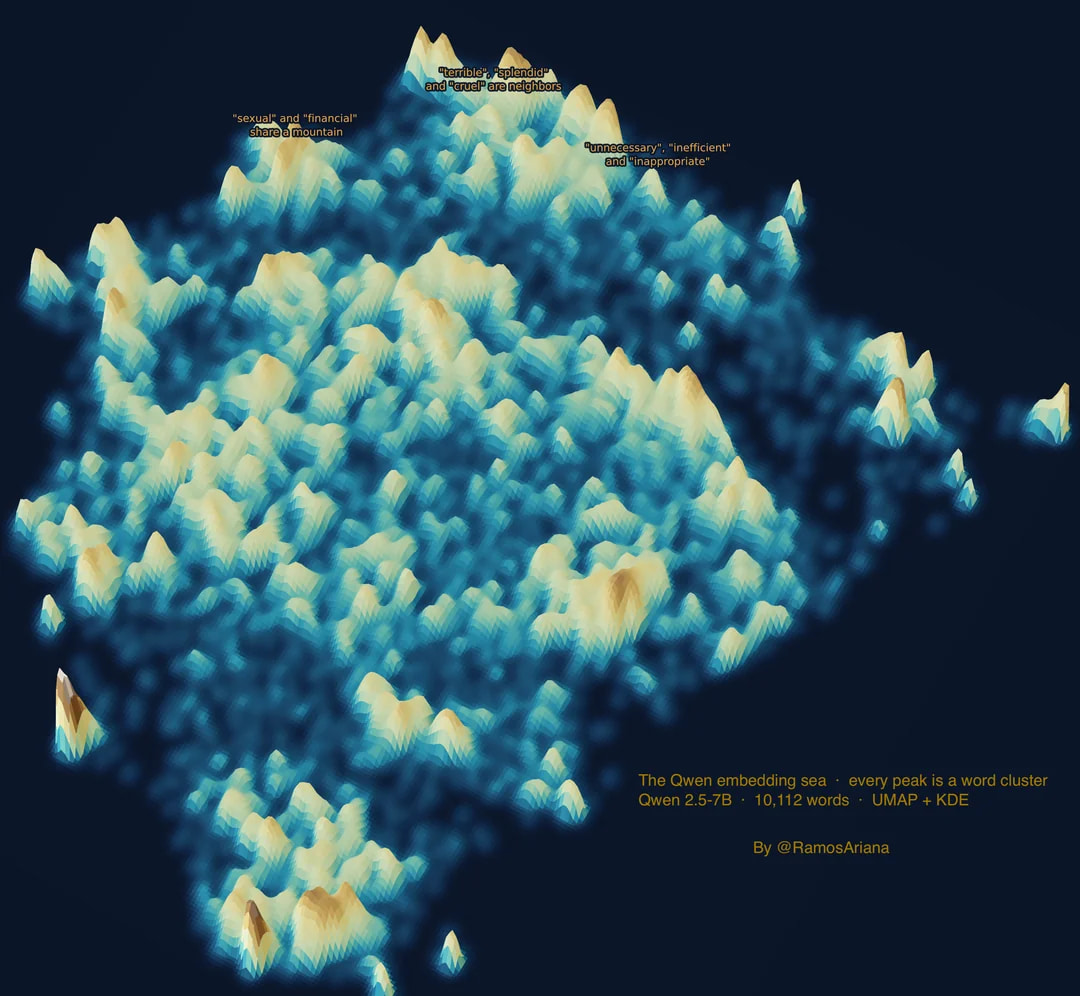
The Qwen embedding sea by Ariana Ramos, a blue and gold topographic rendering of clustered word embeddings
The Qwen Embedding Sea // Ariana RamosQwen 2.5-7B // 10,112 filtered words // UMAP + KDE // move to inspect

The harness supplies the coupling. It does not have to supply the interpretation.

Ariana Ramos recently published an image she calls the Embedding Sea: a topographic map of Qwen 2.5 7B's input embedding space.

In the image, items represented similarly by the model occupy nearby territory. Dense regions rise into mountains; sparse regions sink into ocean. Some neighbours are initially surprising. “Terrible,” “splendid,” and “cruel,” for example, appear close together—not apparently because they share sentiment, but perhaps because they share something more like intensity.

There are cautions around any map like this. Qwen represents tokens rather than a tidy dictionary of whole words, and a two-dimensional UMAP projection cannot by itself prove which semantic property explains a neighbourhood. But as exploratory interpretability, the image is compelling. It offers a geography of the model before anything happens: the terrain on which inference will begin.

“This is the starting landscape before inference.”

Ariana's larger proposal begins where the map ends. She is considering an open-source language model fine-tuned for creativity and conversation, informed by interpretability work and equipped with what she calls “actual introspection capability.” Because its processing could be observed during inference, the model might learn to reflect upon that processing.

A researcher seeing inside a model does not automatically mean the model sees inside itself. Inspection and introspection are different things. But that distinction does not dispose of the proposal. It reveals a smaller and more testable question hiding inside it.

What happens if a model is given a sensory channel onto its own hidden activity?

Concept artwork contrasting circuit-like traces with a dense red neural field and a single gold disc
Concept plate 01 // Signal and substrateSupporting artwork supplied for this note // interpretive image, not a scientific diagram

An interpretability instrument reports to us. A self-sensing instrument would have to report back into the process it measures.

Ordinarily, activation values, feature readings and trajectory plots appear in a dashboard for a researcher. Even if we translate them into English and paste them into a prompt, a model may encounter them as arbitrary tokens. It has not necessarily learned that those tokens stand in a lawful relationship to its own computation.

Instead, imagine compressing some measurement of the model's state into a tiny, stable signal: perhaps a learned projection of residual-stream activity, activation norms, uncertainty, trajectory stability or related measurements. Eight values, say, returned during generation. No labels. Nobody announces that the third value means confusion or that the fifth predicts contradiction.

The model generates. Its internal state is measured. The measurement conditions what it does next. Its action changes its state, producing another measurement. Across training, it can discover whether those signals bear any useful relationship to its future behaviour.

This is less like giving Qwen a microscope pointed at its neurons than giving it interoceptors: artificial counterparts to the channels through which organisms encounter their own bodily condition. Or, less formally, giving it nerve endings.

01Inspection

We observe the model's internals.

02Telemetry

A measurement is supplied to the model.

03Conditioning

The signal changes subsequent behaviour.

04Regulation

The model learns how the signal predicts or controls itself.

05Introspection?

The deliberately unresolved naming question.

Concept artwork pairing vertical gold signals in a red circular field with a dense glowing neural network
Concept plate 02 // Readout and fieldArtwork supplied for this note // interpretive image, not a scientific diagram

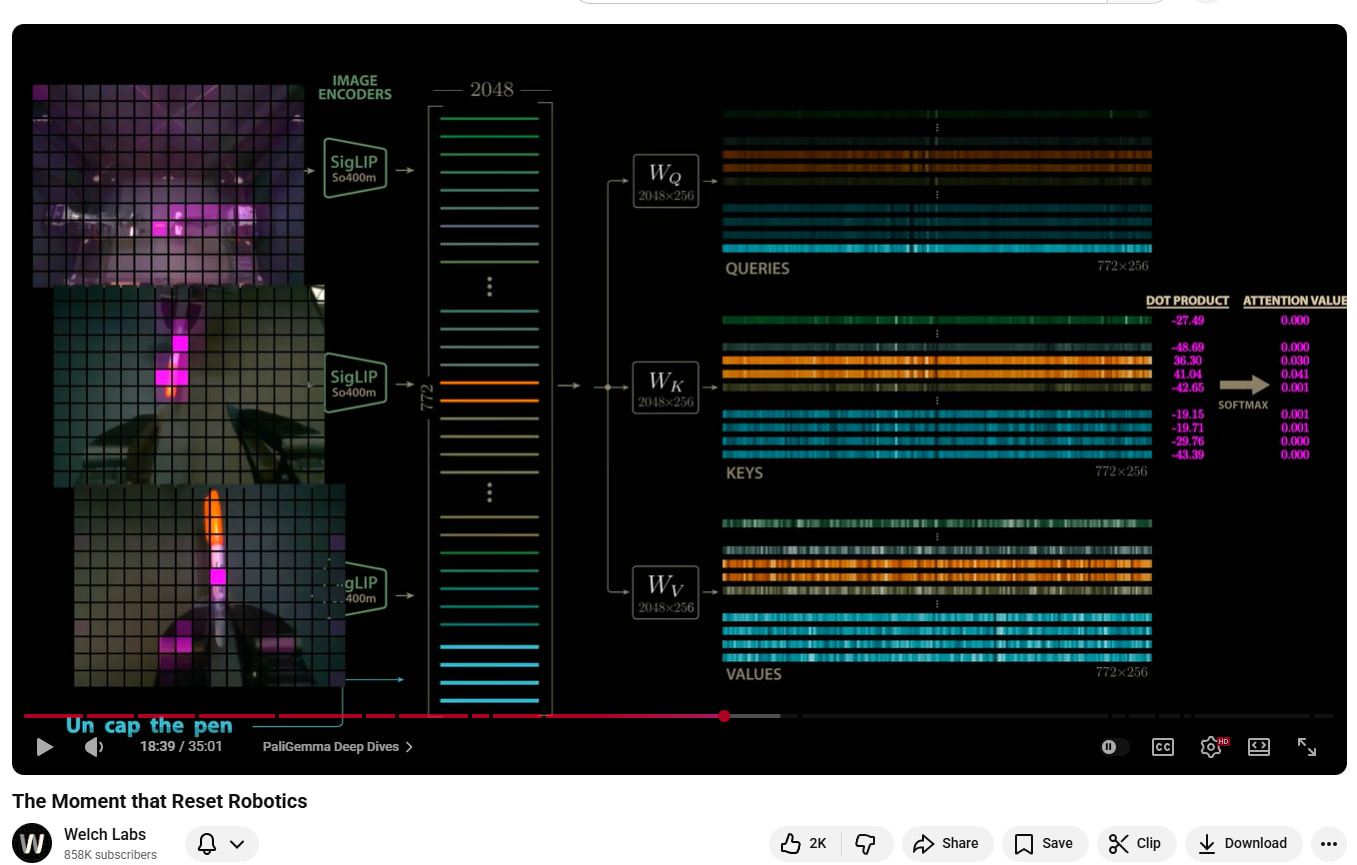
At 18 minutes and 39 seconds into a Welch Labs video about robotics, the token pen appears to find the pen.

The site's essay pauses on the frame in Have We Bridged Semantics and Physics?. PI Zero receives three camera views of a robot's workspace. Image patches and four text tokens—un, cap, the, pen—enter the same attention system.

The query derived from pen is compared with keys derived from all the text and image positions. Nearly every displayed attention value rounds to zero. Two image patches do not: the patches containing the physical pen. Their attended values pass downstream into an action expert that constructs trajectories for the robot's actuators.

Word → image patch → latent state → movement.

They describe this as a bridge between semantics and physics. The functional bridge is real: a token affects attention; attention selects visual information; that information affects physical action.

One qualification matters. PI Zero uses a vision-language backbone derived from PaLI⁠Gemma, pairing a Gemma language model with SigLIP image encoders and multimodal training. Text pretraining plausibly contributes a rich conceptual prior, but the bridge is not simply discovered complete inside a text-only model. Multimodal training teaches the joint system how linguistic and visual representations align.

Still, a latent representation does not have to be translated into human language before it becomes behaviourally useful. It can pass directly into another learned system and acquire meaning through what that system successfully does with it.

PI Zero attention visualization showing the token pen attending to image patches containing a physical pen across three camera views
PI Zero attention // The word finds the objectFigure via Yuin Labs // source frame: Welch Labs, The Moment that Reset Robotics, 18:39

Intrinsic Robotic Introspection seems, at first glance, almost exactly like giving a machine interoceptors.

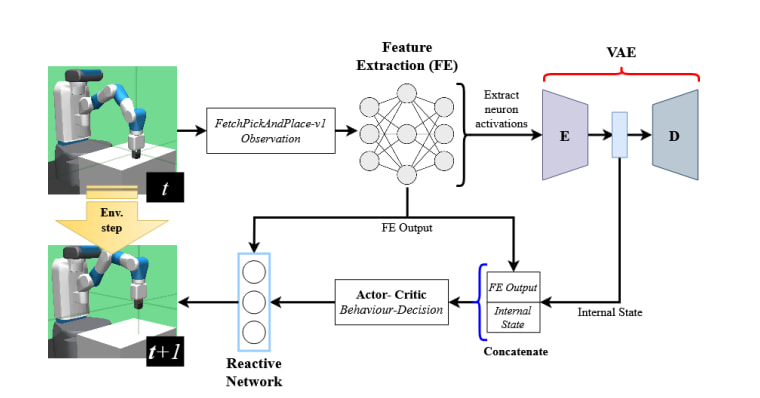
A feature-extraction network transforms the robot's observation into hidden activations. A variational autoencoder, trained to reconstruct 256 of those activations, compresses them into a 50-dimensional latent state. That state is concatenated with the feature extractor's ordinary output and supplied to an actor–critic deciding whether the robot should approach, grasp or retract.

The strongest reported variants reached roughly 80 percent success after around 600–700 episodes, compared with around 2,000 for the baseline. The latent representation was not merely visible to a researcher; it became available to the policy selecting behaviour.

But the architecture exposes a limitation in our earlier shorthand. The “internal state” and ordinary feature output originate from the same environmental observation and feature computation. This is not an independent sensor reading of the robot's condition, nor a temporally recurrent report about how its last decision altered its computation.

Perception → hidden activations → two representations → action.

An austere description is that a compressed summary of hidden perceptual activations provides a useful inductive bias to a downstream controller. It shows that neural telemetry can become behaviourally useful. Calling it introspection imports more than the experiment clearly demonstrates.

Architecture diagram from Intrinsic Robotic Introspection showing feature activations encoded by a VAE and concatenated with feature output for an actor-critic controller
Robotic introspection // Activation-derived statePitsillos et al. // VAE latent concatenated with feature output before behaviour selection

Beyond those two architectural bridges, several other traditions approach different rungs of the ladder.

Behavioural confidenceKnowing what it knows

Models can estimate whether their answers are likely to be correct and can be trained to predict whether they know an answer. Useful metacognition-like behaviour does not by itself prove privileged access to hidden state.

Kadavath et al., 2022 ↗

Privileged self-predictionLooking inward

Models trained to predict their own behaviour sometimes outperform other models trained on the same target behaviour, including after that behaviour is modified. Results are strongest on simple tasks and weak on harder generalization.

Binder et al., ICLR 2025 ↗

Activation-derived stateRobotic introspection

The VAE robot provides the closest named architectural precedent, while also showing the difference between a useful internal representation and a repeated self-sensory loop.

Pitsillos et al., 2020 ↗

Controlled interventionInjected concepts

Anthropic injected known concept vectors into Claude and tested whether it noticed. Opus 4.1 sometimes identified the perturbation before expressing the injected concept, but the effect was fragile and sensitive to injection strength.

Anthropic, 2025 ↗

Persistent plasticitySelf-modifying networks

Fast weights and self-referential networks explore systems that modify their own parameters at runtime. They supply a form of plasticity missing from a frozen transformer, though not necessarily an inward sensory channel.

Irie et al., ICML 2022 ↗

Latent recurrenceThinking without tokens

Recurrent-depth and latent-reasoning architectures recycle hidden representations through further computation. They are close in mechanism, but usually framed as memory or additional compute rather than self-sensation.

The provisional gap is a synthesis: an LLM trained in a closed loop to discover the behavioural meaning of an initially uninterpreted projection of its own live activations. The robotics VAE shows that compressed neural telemetry can assist action learning. PI Zero shows that latent geometry can couple words, images and motor behaviour. Neither establishes recurrent self-sensing.

The missing referent is not an external object like the pen. It is the future behaviour of the process producing the signal.

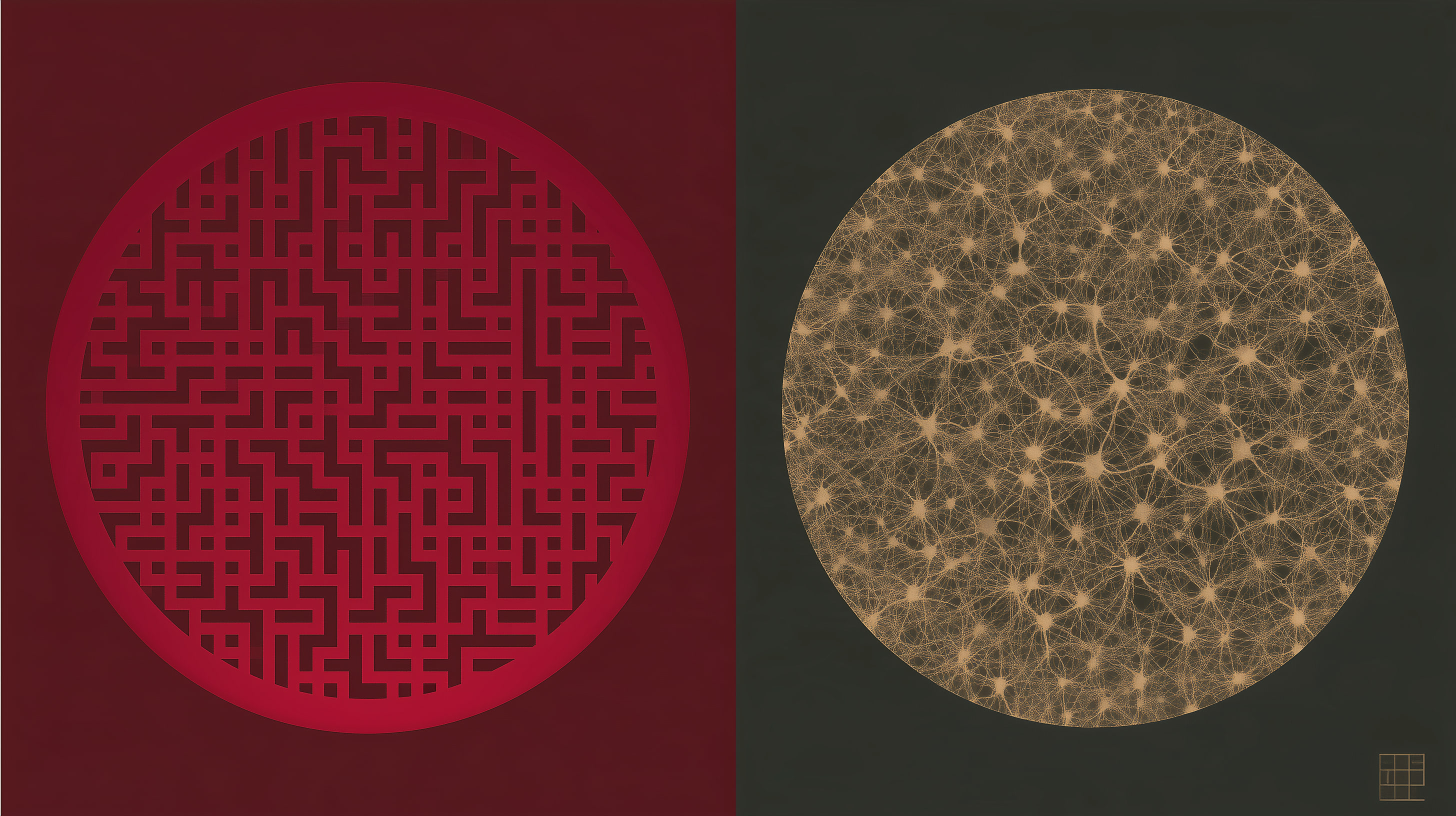
Concept artwork contrasting a red circular maze with an intricate gold neural network in a dark circular field
Concept plate 03 // Designed path, learned pathThe harness selects the interface // the system may learn a use the designer did not name

DishBrain offers a useful intuition precisely because its interface was both minimal and constructed.

In the experiment, cultured human and rodent neurons were connected to a simulated game of Pong through a multielectrode array. Electrical stimulation carried structured information about the game; neural activity affected the paddle; successful and unsuccessful outcomes produced different sensory consequences. Cultures in closed-loop conditions changed their behaviour in ways not seen in controls without structured feedback.

The researchers interpreted this through the free-energy principle, proposing that the cultures altered their activity to avoid states associated with unpredictable stimulation. That interpretation remains a theoretical account, not a magic instruction whispered to each neuron. Nor were the cultures given “nothing”: the experimenters chose the world, the coupling and the consequential asymmetry.

The harness supplied the coupling. It did not have to supply a symbolic explanation of the coupling.

The analogy has limits. Cultured neurons can alter their dynamics and connectivity while inhabiting their world. A frozen transformer changes activations and context during generation, but not ordinarily its synaptic weights. Training across episodes, persistent memory, recurrent state, online adapters or another form of plasticity may be required before the comparison becomes serious.

Still, a deliberately engineered sensor is not disqualified from becoming a sense merely because an engineer placed it there. Biological proprioception and interoception also depend on specialised channels an organism did not personally invent. What matters is the learned relationship between sensing, acting and consequence.

The first experiment could use the ordinary next-token objective and never once reward a claim of self-awareness.

Minimal interventionGive a small language model a compact signal derived from its own preceding activity. Do not explain the signal. Train normally. Ask whether it learns to use it.

If the channel is useless, optimization can ignore it. If it lowers perplexity, self-derived state has become functionally available—but that is only the first rung.

A transformer already carries earlier computation forward. An added activation pathway may merely provide extra recurrence, memory, bandwidth or parameters. A performance gain alone would not demonstrate introspection.

Matched noiseRandom signals with the same size and statistical scale.
Shuffled self-stateReal telemetry attached to the wrong prompts or time steps.
Other-model stateTelemetry from a matched copy rather than the acting model itself.
Capacity controlThe same additional parameters without self-derived information.

The stronger result would be privileged self-information. Does telemetry help the model predict its own impending error beyond what can be inferred from the prompt, its output probabilities, added capacity or an equally rich external signal?

Can it detect that an answer is unstable under perturbation? Predict that another inference pass will change its conclusion? Compensate after an internal intervention? Learn when to retrieve, revise, branch, hesitate or stop? Most importantly, does access to a signal from this model improve control of this model more than it improves prediction of another?

If so, “introspection” begins to name a competence rather than a style of narration. Not because the model says what it is thinking, but because it has learned a closed-loop skill involving measurements of its own hidden processes.

Return // Ariana's seaA map shows the landscape. A sense changes how one moves through it.

Signal seven might become meaningful to the model while remaining obscure to us—not as a proposition it can explain, but as a condition under which it has learned to slow down, retrieve, revise or refrain.

Sources and starting points