The world on the other side of the number
I was already treating a parameter as geography.
Midjourney's Style Reference system accepts a numerical code and applies a corresponding visual idiom to an image. A code may alter palette, medium, texture, lighting, composition, or stranger recurring habits that are hard to name individually but unmistakable in combination.
The ordinary use is straightforward: find a look and reuse it. I began using it as a game. I would draw random codes until one revealed a stubborn default world, then try to knock it off that default using the text prompt alone.
The code stayed fixed. The language changed. The question was which channel would win.
Some codes felt weak: a little colour grading, an easily displaced preference. Others behaved more like attractors. Whatever entered them returned wearing the same skin.
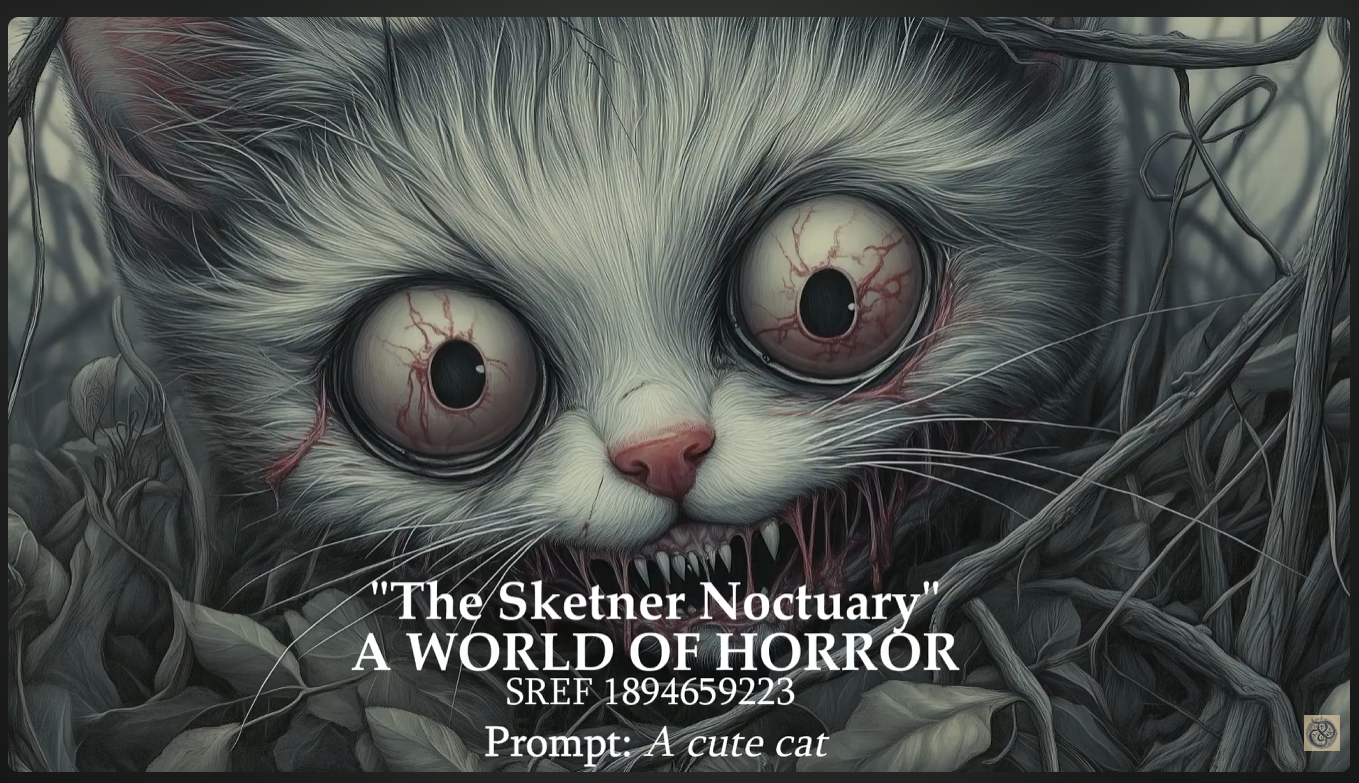
One code in particular produced a coherent figurative horror idiom—recognisably its own, despite the familiar artists one might reach for when trying to describe it. It had motifs and habits. It seemed less like selecting a filter than repeatedly visiting the same visual jurisdiction.
The Sketner
Noctuary
An address
outside
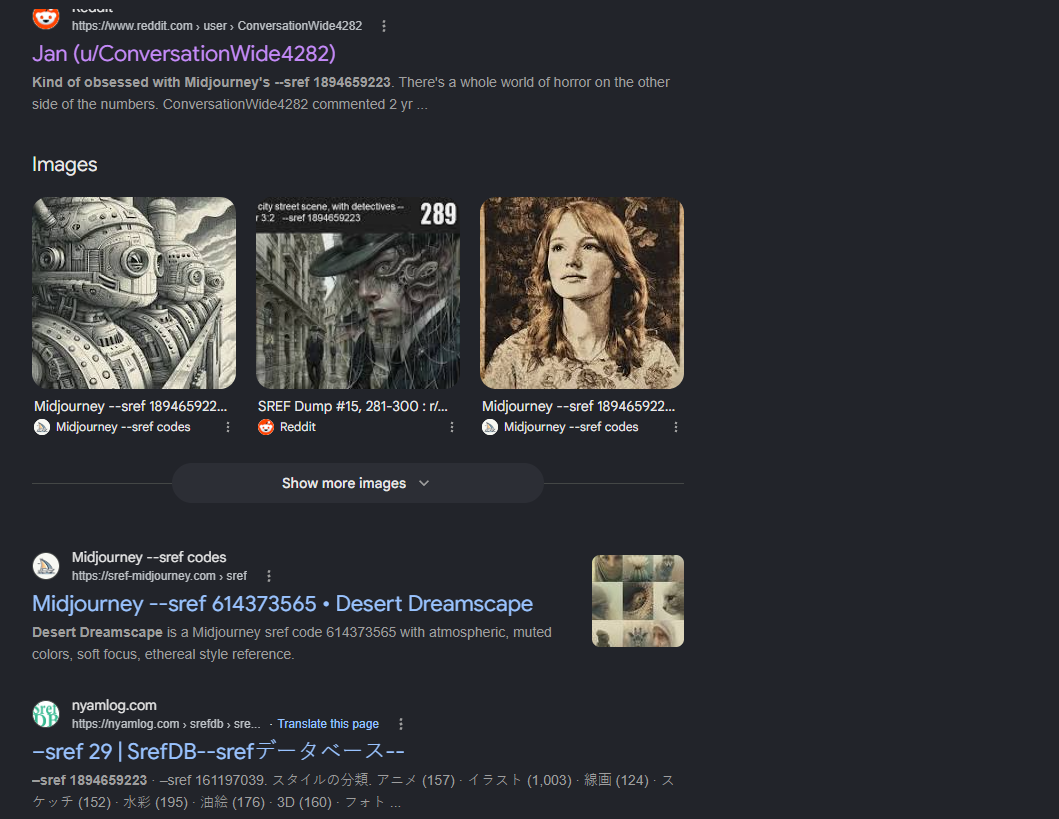
Search the sufficiently unusual string 1894659223 and it resonates outward: images, Reddit posts, videos, code dumps, classifications, and catalogs in more than one language.
The screenshot does not establish what the number means inside Midjourney. It demonstrates something simpler. The string is also an address in the public web: a shared index into content made by people who encountered, recorded, classified, or became fascinated with the same code.
A number
becomes a place
There is no publicly documented reason to expect neighbouring SREF codes to be aesthetically adjacent. The number behaves as an address, not a visible coordinate. Yet people map these addresses anyway: collecting, testing, tagging, publishing, exchanging favourites, and giving particular codes reputations.
This is not necessarily semantic meaning. Nobody has shown that the integer itself signifies horror, architecture, or melancholy. Its meaning is indexical: it points somewhere repeatable. Once people can say “go to this number and look,” an opaque address space begins accumulating culture.
The atlas is not supplied by the operator. It self-assembles from expeditions, screenshots, names, rumours, rankings, and remembered encounters. Search indexing then adds another layer: the address points not only toward a style within the model, but toward the human residue gathered around that style.
A search result is evidence of discoverable public traces, not proof of a coherent community, a latent coordinate system, or an intrinsic meaning encoded by the number. “Community” here can be as loose as separately authored material made mutually findable by an unusual shared string.
The inversion came later.
A SREF takes a number and returns an aesthetic: number → style. J-Space takes an authored string and returns a number: string → destination.
In the SREF game, the address is fixed and language tries to alter what emerges from it. In J-Space, language is the only input channel and the integer becomes the destination. The earlier game was a contest between style and semantics. The later system makes semantics responsible for navigation.
SREF taught me to look at an opaque parameter and ask whether it could be travelled.
It showed that exploration does not require a smooth map; that a catalog can be made from isolated landings; that a landmark may begin as a reproducible surprise; and that people can lay folklore over an address system whose internal organisation they cannot see.
A number can become a place because somebody went there, returned with evidence, and made it possible for somebody else to follow.