upanddown
The peak waits for completion.
Across the studied examples, 541's highest activation generally occurs as the second member finishes the construction. The position matters as much as the vocabulary.
A profile of GPT-2 Small's layer-5 neuron 541: the pairs it notices, the controls it survives, and the limits of what one neuron can be said to mean.
Not every pair. Not merely the word down, or the word one, or a convenient and. The strongest responses arrive when two members and their connector complete a learned relationship.
Across the studied examples, 541's highest activation generally occurs as the second member finishes the construction. The position matters as much as the vocabulary.
“Oh,” said the Bear. “It isn't the halves. It is the second half arriving where it belongs.”
For each string, every layer-5 neuron's highest post-nonlinearity activation anywhere in the sequence is recorded. If 541's maximum exceeds every other neuron's maximum, 541 is the destination for that string.
Natural corpus strings resolving to L5-N541 were whittled and then exhaustively minimized. V9 produced 47 exact certificates; the median exact certificate was three tokens.
Members, order, connector, carrier, endpoints, malformed frames, and continuations were varied to ask whether a single word or memorized phrase could explain the response.
Repeated-member constructions, familiar and novel forms, connector matrices, pronominal variants, and destructive controls tested how far the pattern generalized.
Ablation, replacement, injection, positional controls, and matched-neuron controls moved the study from observational phenotype mapping toward causal qualification.
Representative logic from the controlled panels. The comparison is not just between pretty examples; it asks which ingredients can be removed or replaced before the response collapses.
Counts summarize the six recurrent seed pairs across four carrier contexts in V10. “Win” means 541 was the largest layer-5 peak under the scoring rule above.
A connected repetition such as “gravel after gravel” exceeded its matched unrelated form.
Novel repeated structure raised 541 systematically, even with unfamiliar lexical material.
The structural increase was real but insufficient to make 541 the strongest neuron.
Learned lexical and constructional compatibility amplified the structural response.
Progressive removal at the completed construction produced a monotone, position-specific change and usually reduced declared continuations.
Positive injection changed the distribution but did not reliably transfer the route family.
Forcing 541 on prematurely at the connector suppressed the expected member in every tested case and dose.
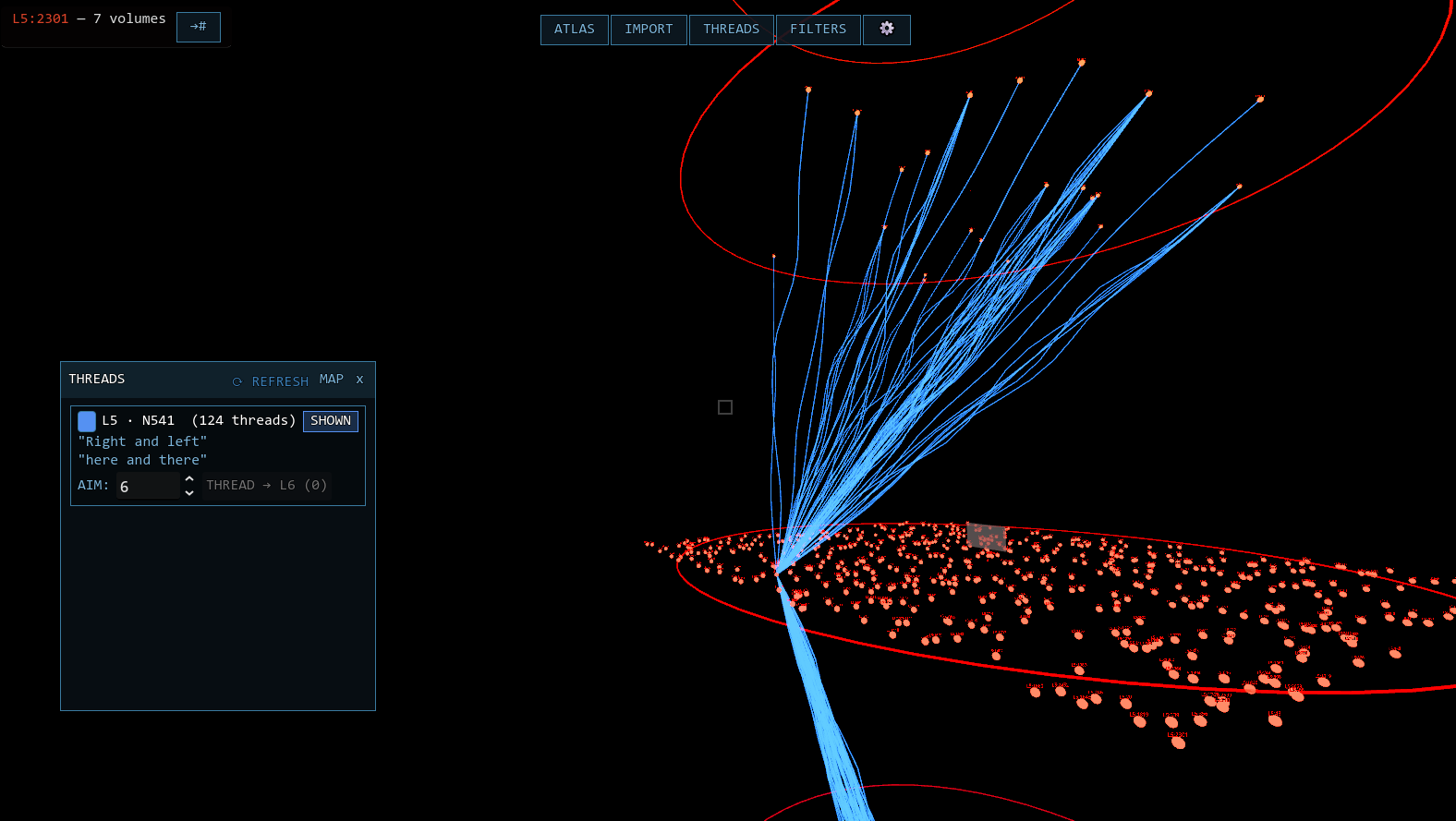
The same 80 MAE rows were replayed through all twelve layers. At L6 they split among 22 winners, led by neuron 2374. A seeded sample of 80 unrelated sentences from the same corpus reached a different, more diffuse distribution of 36 winners.
This is the empirical material later drawn as threads and bundles inside Godot: fixed strings, repeatedly measured, with their layer-wise winners joined into routes.
A landmark discovered by control.
L4 neuron 923 wins all 80 selected MAEs—and all 80 unrelated control sentences—at nearly constant activation. That makes it a poor candidate for a 541-specific pairing precursor under this measurement. Argmax alone can conceal content-sensitive runner-ups beneath a generic winner.
The initial characterization emerged through creator-led and AI-assisted tests. Only afterward were OpenAI's neuron viewer and Neuroscope consulted, as independent points of comparison: a way to check the emerging account against examples and descriptions produced elsewhere. They belong to the validation history, not the discovery origin.
Neuron 541 is selectively sensitive to the completion of connected parallel-member constructions, with graded contributions from lexical members, connector, position, familiarity, and constructional compatibility.
“The parallelism neuron” is memorable shorthand, not an ontological claim. The evidence does not show that 541 literally represents parallelism or uniquely performs an abstract grammatical operation.
The intervention and thread results place 541 inside a larger, position-sensitive system. A neuron profile is a measured behavioural portrait, not a complete theory of the network.